
AI Did Not Remove Cost. It Changed the Type of Cost.
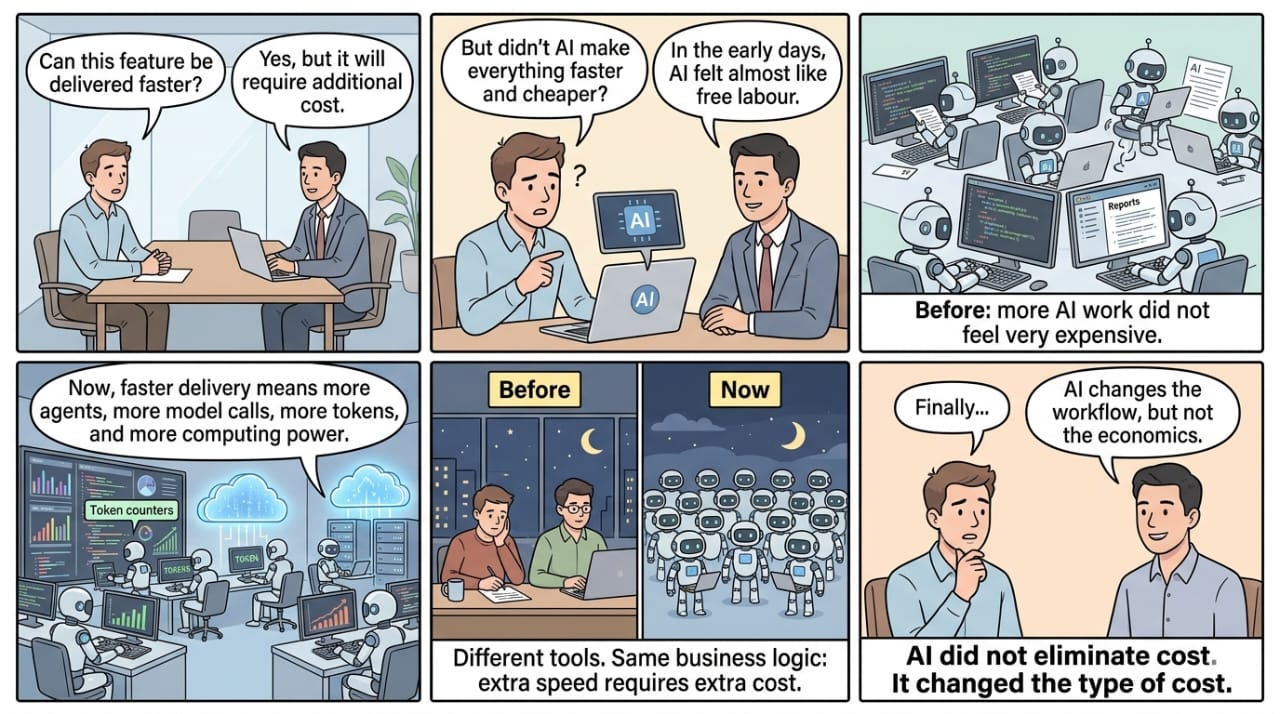
AI does not remove project cost. It changes cost from manpower to intelligence power, including AI agents, tokens, model calls, and computing resources.

Many people assume that because AI makes work faster, it should also make everything cheaper.
But in real projects, this is not always true.
When a client asks:
“Can this be done faster?”
The answer may still be:
“Yes, but it will require more resources.”
Before AI, faster delivery usually meant:
More developers
More designers
More testers
More overtime
More coordination
More people meant more cost.
Now, with AI, faster delivery may mean:
More AI agents
More model calls
More tokens
More automation workflows
More computing power
More human review
The cost has not disappeared.
It has simply changed form.
In the past, we paid mainly for manpower.
Today, we are also paying for intelligence power.
AI can help us move faster.
It can reduce repetitive work.
It can support writing, coding, planning, research, and automation.
But AI is not free labour.
Behind every AI output, there are still costs: tools, subscriptions, API usage, cloud infrastructure, and human validation.
So the old business logic still remains:
Extra speed requires extra resources.
The only difference is the explanation.
Before AI:
“We need more people, so we need more budget.”
After AI:
“We need more AI resources, so we need more budget.”
AI changes the workflow.
AI changes the speed.
AI changes the type of cost.
But AI does not remove the economics of work.
So the next time someone asks:
“Can you make it faster?”
The honest answer may still be:
“Yes. But faster still costs more.”
A Real-World Example: GitHub Copilot
A good example is GitHub Copilot.
In the early days, many people saw AI coding assistants as a simple monthly subscription tool. You paid a fee, used the assistant, and the cost felt predictable.
But as Copilot evolved from simple code suggestions into chat, code review, and agent-style workflows, usage became more resource-intensive.
GitHub announced that Copilot plans would move toward usage-based billing using GitHub AI Credits, where chat, agent mode, code review, CLI, and apps consume credits based on AI usage. GitHub also explained that agentic coding workflows bring higher compute and inference demands compared with simple coding suggestions. [github.blog], [github.blog]
This shows the bigger pattern:
The more powerful and autonomous the AI becomes, the more important cost control becomes.
The same idea applies to AI APIs. OpenAI’s API pricing is also based on usage such as input tokens, cached input, output tokens, tool usage, and model type. More advanced models and heavier workflows usually cost more to run. [developers...openai.com], [openai.com]
Closing Note
At Ler Tech Notes, I write about AI from a practical and business-aware perspective.
AI is exciting, but we need to understand not only what it can do — but also what it really costs.