
The Zero-Click Extinction: Why AEO is the Only Strategy Left for Brand Survival in 2026
Is your brand prepared for AI-driven search? Learn the counter-intuitive takeaways behind the zero-click extinction and why shifting from SEO to AEO is the ultimate strategy for 2026

1. Introduction: The Era of the Zero-Click Search
The digital marketing landscape is currently navigating a “Zero-Click Crisis.” For decades, the primary objective of a strategist was to earn a spot in a list of blue links to drive traffic. Today, we are witnessing the sunset of the deterministic search era. Traditional organic traffic is in a precipitous decline as Large Language Models (LLMs)—led by Google’s “AI Overview”—satisfy user intent directly on the results page.
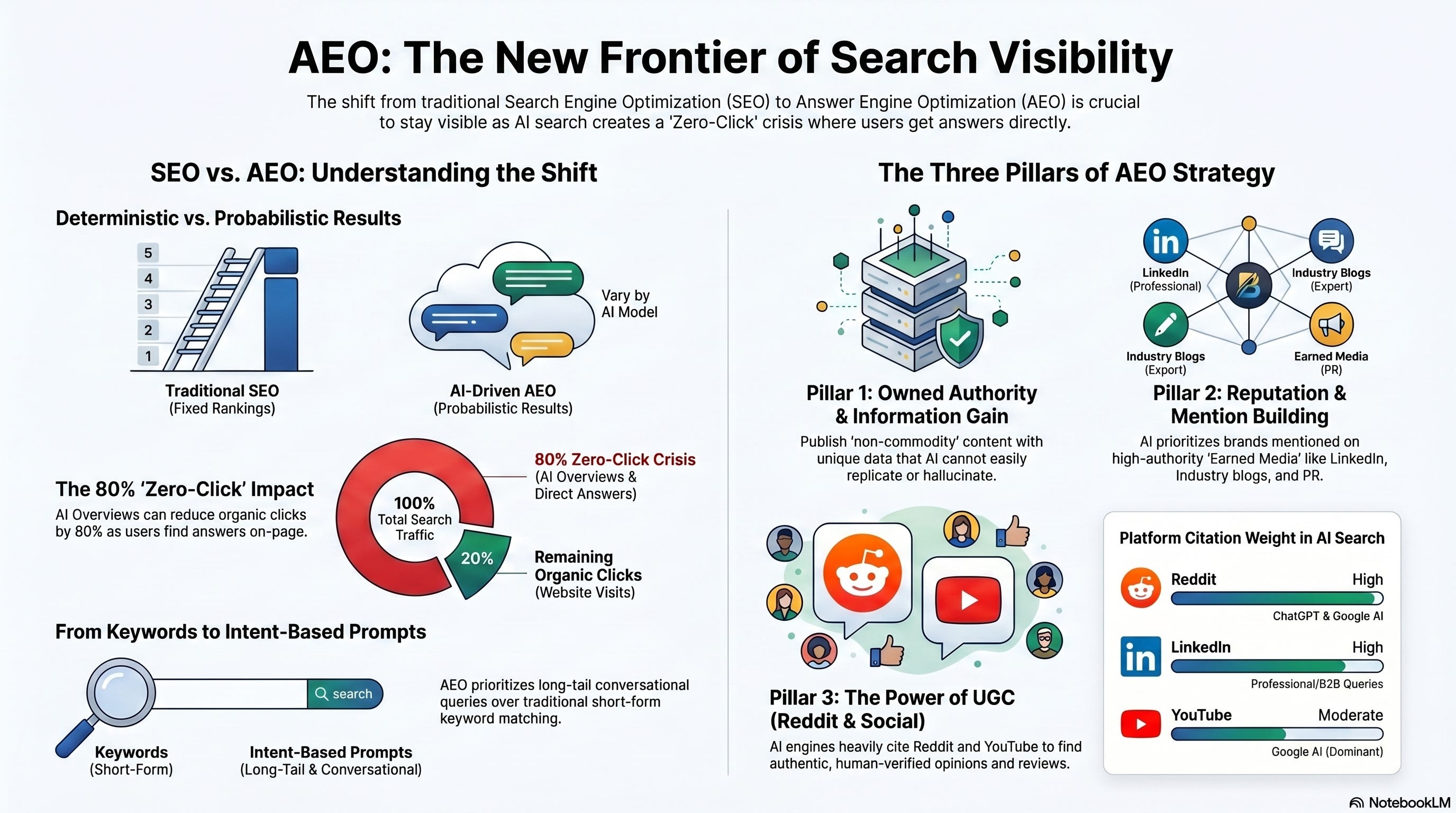
The data is sobering: our research at Query indicates that when an AI overview appears, there is a staggering 80% drop in clicks to external websites. Because the AI synthesizes information into a cohesive answer, the user often finds everything they need without ever leaving the search engine. This shift necessitates an immediate pivot from traditional Search Engine Optimization (SEO) to Answer Engine Optimization (AEO).
2. Takeaway 1: SEO is Deterministic, but AEO is Probabilistic
The fundamental paradigm shift lies in how information is retrieved. Traditional SEO is “deterministic.” If you search for a specific term today and tomorrow, the results are largely fixed and predictable—ranking Company A, B, and C in a set order.
In contrast, AEO is “probabilistic.” Results are highly volatile, changing based on the specific prompt, time, and perceived intent. Vlad, CEO of Query, notes that results in this new environment can exhibit a 50% volatility rate day-to-day.
To understand this volatility, one must understand the technical process of Query Fan-out. When a user enters a prompt, the AI does not simply “search.” Instead, it breaks that single prompt into 50–100 related queries, performs 10–15 actual web searches, and then re-ranks the fetched pages based on intent. Brands can no longer prioritize “ranking #1”; they must instead focus on being a consistent part of the AI’s “probability pool” during this complex investigation process.
3. Takeaway 2: The “Answer-First” Content Revolution
AEO requires a radical restructuring of content through a method known as “Semantic Front-loading.” AI engines no longer have the patience for long-form filler or “burying the lead” to hit arbitrary word counts. They reward “non-commodity” writing that provides immediate utility.
As established in our strategic frameworks:
“The paragraph directly below the heading should address the question immediately.”
This challenges traditional “commodity” content. If your writing doesn’t offer a direct answer in the first few sentences, the AI will likely skip your site during the retrieval phase in favor of a more concise competitor.
4. Takeaway 3: Authority is Out; Reputation is In
In the old world, “Authority” was a technical metric defined by backlinks and domain ratings. In the AEO era, “Reputation” is the new currency. To the AI, it is not enough for your website to be technically sound; your brand must be “famous” across the platforms the AI trust.
This has birthed the concept of “Fame Engineering.” For small-to-medium enterprises (SMEs) that cannot out-rank global giants on their own domains, we recommend a Parasite SEO strategy. This involves leveraging the high authority of third-party platforms like LinkedIn, Medium, or news portals to host your most important perspectives. When an AI sees your brand mentioned across multiple reputable, high-trust sources, its “confidence factor” increases, making it significantly more likely to cite you as the definitive answer.
5. Takeaway 4: The Strategic Supremacy of Reddit and User Content
One of the most critical shifts in AI discovery is the reliance on user-generated content (UGC). Our research shows that Reddit currently owns nearly 60% of all UGC citations in AI search results. AI engines prioritize Reddit because they are seeking “real human insights” to filter out the noise of “AI slop.”
For brands, this requires a Diversified Retrieval Strategy:
Google: Prioritizes YouTube content because it has native access to that data.
ChatGPT: Currently ignores YouTube but leans heavily on platforms like Reddit and LinkedIn for professional and human perspectives.
If your brand is invisible on these human-centric forums, you are effectively invisible to the LLMs.
6. Takeaway 5: Information Gain Over “AI Slop”
To be cited, your content must provide “Information Gain.” We define this as the literal metric of novelty: the percentage of content within an article that does not exist anywhere else on the web. Generic content produced by “one-shot” AI prompts is increasingly ignored.
To motivate an AI engine to crawl and cite your site, you must provide:
“first-party research, unique perspectives, and expertise that AI cannot easily replicate.”
Proprietary case studies, unique statistics, and deeply opinionated expert insights are the only defenses against the “slop” that search engines are now actively de-ranking.
7. Takeaway 6: Conversion Quality vs. Traffic Quantity
While AI-referred traffic currently accounts for a small slice of the pie—ranging between 0.26% and 1.08% of total web traffic—the quality of these users is unprecedented.
Data indicates that AI-referred traffic converts approximately 9% better than traditional search traffic. This is because the AI acts as a high-intent filter. It answers the basic, top-of-funnel questions for the user, meaning that those who actually click through to your site have already been “pre-qualified.” They aren’t just browsing; they are ready to act.
8. Conclusion: The Future of “Search Everywhere Optimization”
SEO is not dead, but it has evolved into a foundational layer beneath a more sophisticated AEO strategy. To remain competitive, brands must ensure “Retrieval Readiness.”
One critical technical asset for the modern brand is the LMCXT (Large Language Model Context) file. We recommend implementing a markdown-based LMCXT file in your root domain. This file acts as a machine-readable directory that helps AI engines instantly interpret your brand facts, key links, and core identity.
As we move into 2027, you must ask: Does your brand exist within the AI’s “knowledge graph,” or are you invisible to the next generation of consumers?
Final Takeaway: Audit your “Retrieval Readiness” today. If an AI cannot find, understand, and trust your information in seconds, your brand will not survive the Zero-Click Extinction.